The Psychological Stake in Greenland
With the next big media-geopolitical moment shifting to Greenland, we find ourselves amidst many interesting discussions revolving around precisely what it is about the hoary territory that has captured Trump’s unanimous obsession.
One interesting proposition has been put forth in a new piece by Michael McNair. It elaborates on the theory that Under Secretary of Defense for Policy Elbridge Colby is the true architect behind Trump’s Greenland grab, and in fact outlined his vision for this very maneuver in his 2021 book, The Strategy of Denial: American Defense in an Age of Great Power Conflict.

The article asserts that, just like the ‘hidden hand’ of Heritage Foundation’s Project 2025 was suspected to have provided the underlying ‘script’ for Trump’s second term—despite profuse denials—in the domestic sphere, Elbridge Colby’s ‘playbook’ is likewise secretly shaping Trump’s vision for not only Greenland—with the territory merely being one key cog in the overall scope—but the wider American geopolitical strategy, which includes the newly reinvisioned ‘Donroe Doctrine’.
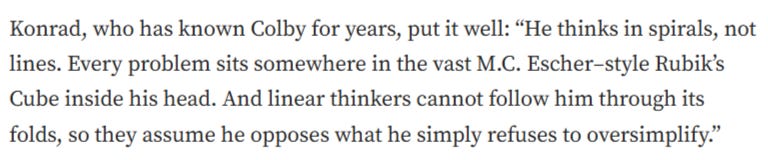
The piece quotes John Konrad in describing Colby’s influence inside the Pentagon:
“…aside from Hegseth, the most powerful gravitational body in the building is Elbridge Colby.” He added that Colby’s “grand strategy remains exactly what he published in his books and interviews long before taking office. He is executing it now.”
It goes on to praise Colby’s ‘sophisticated’ strategic thinking, implying at every turn that he is a rare and generational savant under whose stewardship the US’s geopolitical interests will be impeccably served.
What distinguishes Colby from most strategic thinkers is his recognition that strategy operates as a complex adaptive system. He doesn’t ask “what should we do about Taiwan?” in isolation. He asks “what is China’s optimal strategy, and how do we make that strategy fail?” He thinks through second and third-order effects, understands how actions in one theater affect capacity in another, and builds a framework where the pieces actually connect.
Of course, if you really pay attention to the author’s description of his genius, you quickly realize Colby is not the great thinker he is made out to be, but is rather a typical one-dimensional American neocon strategist capable only of processing the world through a shallowly binary and adversarial mindset, which is what sets him apart from the people who run policy in civilizational states like China. American neocons can operate only from the imperial vantage, utilizing the modalities of hostility and game-theoretic resource control.
It’s no surprise then that Colby happens to be descended from the “best” of them:

Is this true strategic virtuosity, or merely the same old clannish nepotism?

In short, he is a dangerously brilliant man, we are to assume. Thus, his carefully plotted Greenland campaign will be one of the most impressive strategic masterstrokes of the century.
What is his strategy, exactly, as outlined in his earlier-mentioned seminal book? The author summarizes for us:
Colby’s core claim is that U.S. strategy in the 21st century should aim to prevent China from achieving hegemony over Asia. The rest of his framework follows from that point.
Simple enough, but here’s the kicker:
Even the Western Hemisphere focus fits his framework. Securing the home base is not a retreat from Asia. It is a prerequisite for sustaining power projection into the Indo-Pacific. You cannot fight a war in the Western Pacific if hostile actors control your southern approaches.
He wrote the playbook. Now he is running it.
In short, the claim is that the White House’s strategy currently being played out is not a Monroe Doctrine-esque “retreat” from the outer world as many have assumed, with the US focusing on a ‘Fortress America’ strategic enclave in the Western Hemisphere, but rather is a fully offensive strategy aimed at impeding China from its now-inevitable ascendancy. The US’s focus on “interior” projects like Venezuela and Greenland is meant only to empower the US to act abroad by stripping China and other adversaries of life lines and advantages, etc.
This seems logical enough.
It is in essence a repudiation of this famous meme making the rounds, which implies Trump is willfully dividing up the world by ceding remaining hemispheres to Putin and Xi.
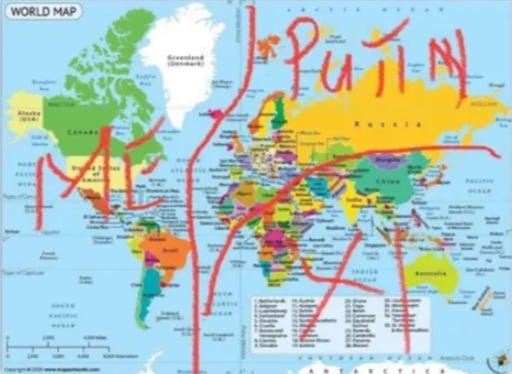
The idea is summarized by this key section:
The confusion comes from mistaking prioritization for abandonment. When Colby argues that Europe should take primary responsibility for its own defense, he is not saying “Russia gets Europe.” He is saying Europeans have the resources to handle their own continent, so American resources should concentrate where they are actually needed for the balance of power to hold.
The Western Hemisphere focus is not America retreating to its corner either. It is securing the base of operations. You cannot project power into the Indo-Pacific if hostile actors control the Gulf shipping lanes, your canal access, or critical supply chains in your own hemisphere. The Monroe Doctrine reassertion enables the Asia strategy. It does not replace it.
Despite my facetious tone, the content of the article is likely accurate: it is true that the US does not appear to be “retreating” into its sphere; it is clearly still intent on dominating the Middle East for the sake of Israel, as we are now witnessing play out with the Iranian saga, interventions against Houthis, etc. Instead the ridicule is aimed at the idea that Colby’s so-called ‘strategic vision’ can actually succeed while ignoring real second and third order consequences, which are already beginning to manifest.
The most notable of these consequences is obviously the total alienation of US’s core allies, which—one would think—somewhat counterbalances any “strategic gains” the US achieves with the acquisition of new territory.
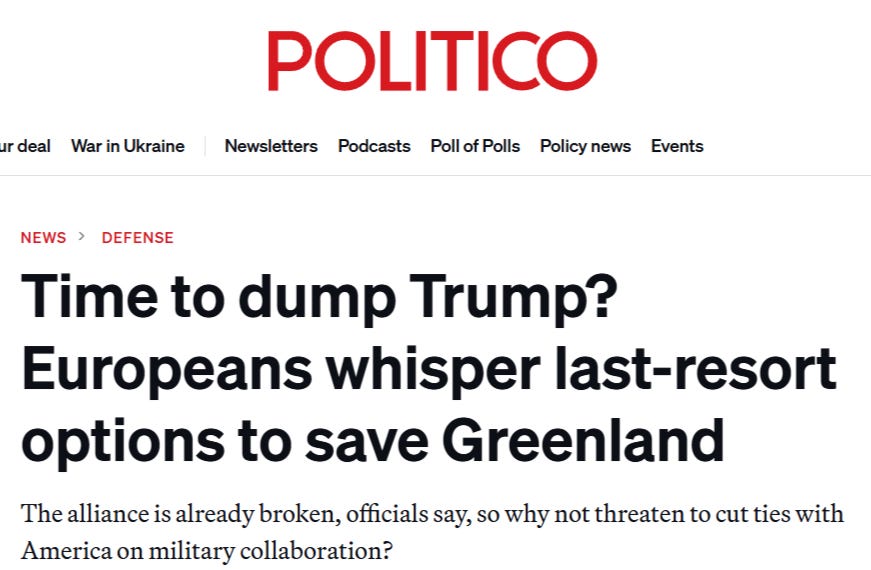
For instance, the above Politico piece reveals that European officials are ‘quietly’ discussing sensitive possibilities which include taking away US’s European bases, which allow the US to project its force into key theaters, most notably the Middle East.
But the possibility of cutting off support for American military deployments has come up, including radical suggestions to take back control of U.S. bases, one of the diplomats said.
“Discussions are ongoing on how could we put pressure and say ‘Hey, you need us, and if you do this we are going to retaliate in some way,’” the diplomat said. “But at the same time, nobody wants to speak out about this.”
Granted, the Europoodleans have become such timorously slavish little sycophants that it’s extremely difficult to imagine them ever growing the backbone necessary to follow through on the above threat, so perhaps we can credit Colby’s boldness here with foreseeing their lack of fiber and gumption. The overall damage to relations, though, cannot be argued. In the zero-sum game of power politics, is it worth gaining an empty territory in exchange for such reputational costs?
Some would argue yes—but for whom?
The Psychological Stake
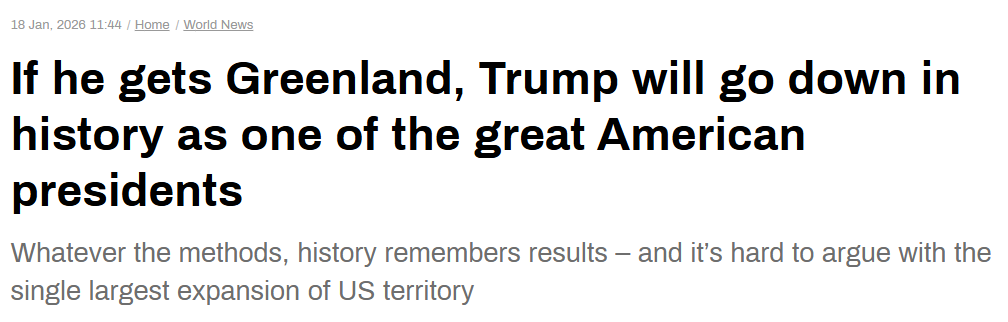
The above piece rightly attests that the acquisition of Greenland would move the US up past Canada into second place of world’s largest territories.
If Donald Trump were to consummate a purchase of Greenland, he would almost certainly secure a place in both American and global history.
Beyond the spectacle, the scale alone would be staggering. Greenland spans roughly 2.17 million square kilometers – making it comparable in size to the entire Louisiana Purchase of 1803 and larger than the 1867 Alaska Purchase. Fold that landmass into today’s United States and America’s total area would jump past Canada, placing the US second only to Russia in territorial size. In a system where size, resources, and strategic depth still matter, such a shift would be read around the world as an assertion of enduring American reach.
Such an assertion, however, is revealing: the echoes of history, grandiosity, magnitude—these appellations do not so much redound to the US’s immediate strategic benefit but rather, it would seem, only to the benefit of one man’s image.
There is a reason why the strategically “imperative” nature of the acquisition has been suddenly played up with artificial threat in the form of claims that Russia and China are lining up to seize Greenland for themselves—yes, the same Russia “hobbling along” in Ukraine and unable to even protect its “shadow fleet” tankers not far from Greenland. If the threat was real, the strategic imperative would be self-evident. But it’s clear from the factitious nature of the charade that it is being artificially engineered without real clear justification; and that tells us that the real motive behind it likely rests in the self-aggrandizement of none other than Trump himself for the vain benefit of his legacy.
What else supports such a thesis? Well, for instance, we know that the US already hosts a major anti-ballistic missile early warning radar base in Pituffik Space Base, in Greenland, which hosts the 12th Space Warning Squadron of the US Space Force. What further advantage would the US gain by outright “owning” Greenland when it’s already allowed to host its massive early warning missile radars there?
The US’s other justifications for the acquisition make even less sense. For instance, here Scott Bessent argues that if Greenland were to be attacked, the US would get “dragged in” via its NATO Article Five guarantee, and so somehow by acquiring Greenland the US would be safer, implying perhaps that if the US officially owns Greenland, attackers would be deterred from invading it:
But that makes no sense, because in the same sentence he admits that the US backs Greenland via NATO guarantees, which means the hypothetical attackers would equally be dissuaded from invading whether the US materially possesses Greenland or not. The only way his argument could possibly make sense is if he knows something we don’t about the US’s future plans to leave NATO entirely.
If you add up all these little incongruencies and logical non sequiturs, it becomes clear that there is no immediate and pressing exigency that requires the US to annex Greenland with the type of urgency being portrayed. Thus, we can only conclude that the purpose of the entire saga is to aggrandize the current administration by puffing up its stature in the annals of history as one that tackled sweeping issues and accomplished monumental feats—even though most of those ‘feats’ will have been inordinately superficial in relation to improving the lives of actual American citizens, which is primarily what the job of the administration is meant to be.
But perhaps the author of the previous piece has a point—American posterity won’t care about the ‘substance’—or lack thereof—and will hail Trump as a historical icon for the simple grandeur and striking boldness of his epic stroke:
How would Trump be remembered at home if he pulled it off peacefully, through purchase? American memory tends to fix on outcomes, not process. The Louisiana Purchase is celebrated for doubling the young nation, not for the constitutional scruples it raised at the time. The Alaska Purchase, derided as “Seward’s Folly,” is now taught as strategic foresight. The sheer scale of Greenland would make it the single largest one‑time expansion of US territory, narrowly edging out Louisiana in raw area. That alone would place any president in the pantheon of consequential leaders; Trump would likely be discussed in the same breath as Jefferson and, by sheer magnitude of territorial change, alongside the transformative figures students learn first.
We must admit the shrewd author makes a very convincing case. In fact, she brilliantly predicts the gradual displacement of any contemporary blowback and ill consequences by the ‘selective-memory’-driven enthusiasm and pride resulting from such a historical feat:
Domestically, opposition would likely be sharp in the moment, especially over process, cost, and precedent. It would be massively amplified by the divisiveness of Trump’s figure. Yet American political memory is selective. If the acquisition delivered clear strategic advantages, and was followed by effective integration and investment, the drama of the negotiations would fade while the map endured. Schoolroom globes would change. So would calculations in defense, climate science, and resource policy. Over time, anniversaries – not the acrimony – would structure how most citizens encountered the story.
The excellently-written article concludes with an apt flourish:
There are, of course, ways this legacy could sour. America remembers big swings, but it also remembers boondoggles. If the path to acquisition trampled consent, sparked long‑running disputes, or failed to deliver tangible benefits, the afterglow would dim and the comparison to Jefferson or Seward would feel strained. For a time.
Still, if Trump were to acquire Greenland, historians would struggle to write the modern American story without giving him a central chapter. The combination of scale, symbolism, and strategic repositioning would be too significant to treat as a footnote. Whatever one thinks of his methods, the legacy question in that scenario is straightforward: the map would testify on his behalf long after today’s arguments have quieted. That is how history so often works. Outcomes, etched in borders, become the monuments.
Who can argue the above? And of course, owing to the pointed veracity of these words, we can conclude that Trump himself has envisioned the full contours of such a playout of events, which we can almost be certain is the primary underlying driver of his arctic ambitions. It has little to do with the ‘Golden Dome’, which we know would benefit little from the nominal US control of the territory given that the US already operates radar bases there, and could easily make treaties to operate more.
In fact, for the unbelievers, Trump even addressed this very issue himself. In an NYT interview he openly intimated that obtaining Greenland is psychologically important for him:
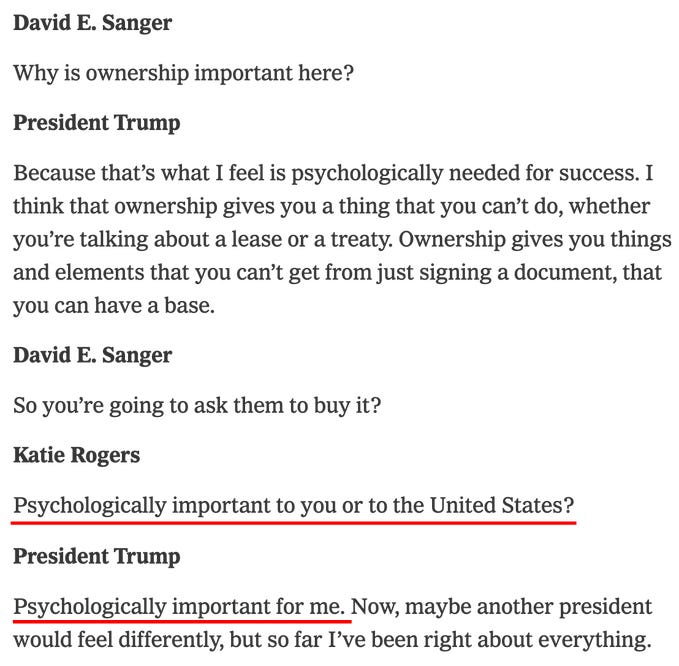
What else can you possibly infer from that?
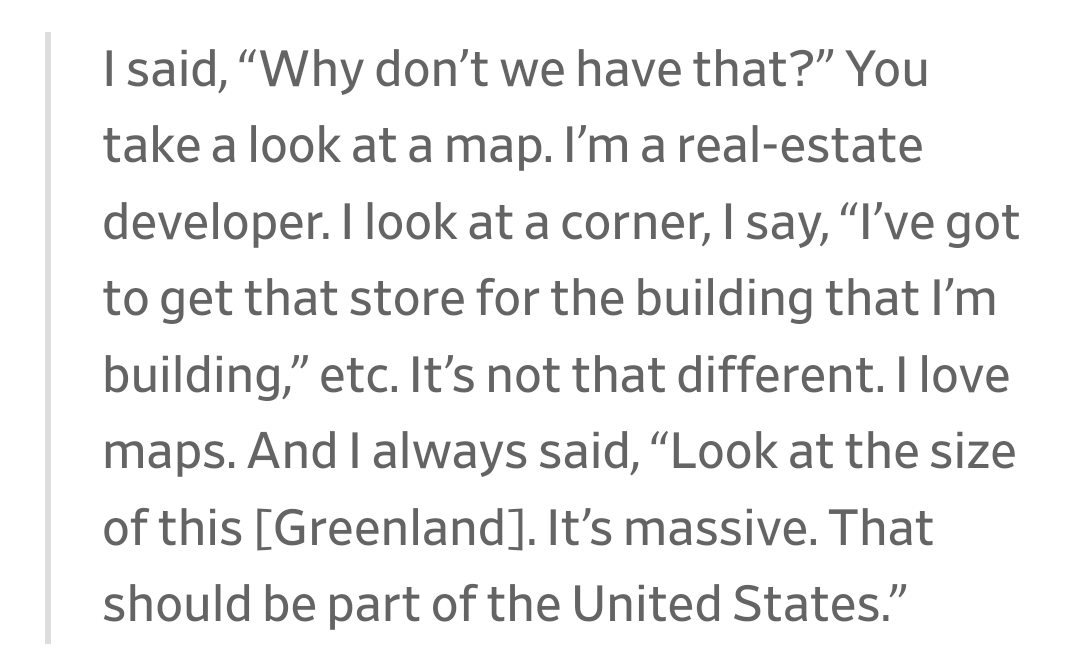
One of the problems is that the larger that Trump’s failures grow, the more psychologically pressed he will be to pursue lofty ‘big-ticket’ geopolitical ‘slam-dunks’ in order to make up for his perceived losses. In Trump’s mind, he likely—correctly—assumes that a big victory can wipe away the stain of even the biggest loss. So, as his other initiatives fail, and his unpopularity grows, he may become increasingly unhinged to perform large-scale geopolitical “miracles” like being the man to take down Iran, acquire Venezuela, Greenland, and even Canada, etc., in order to simply overpower the loss of prestige from his dwindling presidential legacy.
And so, we get vectors like the following:
Donald Trump considers Canada vulnerable to Russia and China in the Arctic, writes NBC.
Canada fears that it could become Trump’s next target after Venezuela and Greenland - Bloomberg.
Meanwhile, the EU may impose retaliatory tariffs against the US over Greenland worth 93 billion euros, reports the Financial Times newspaper, citing European officials.
According to its data, the Europeans’ option for retaliatory actions is to restrict access to the EU market for American companies.
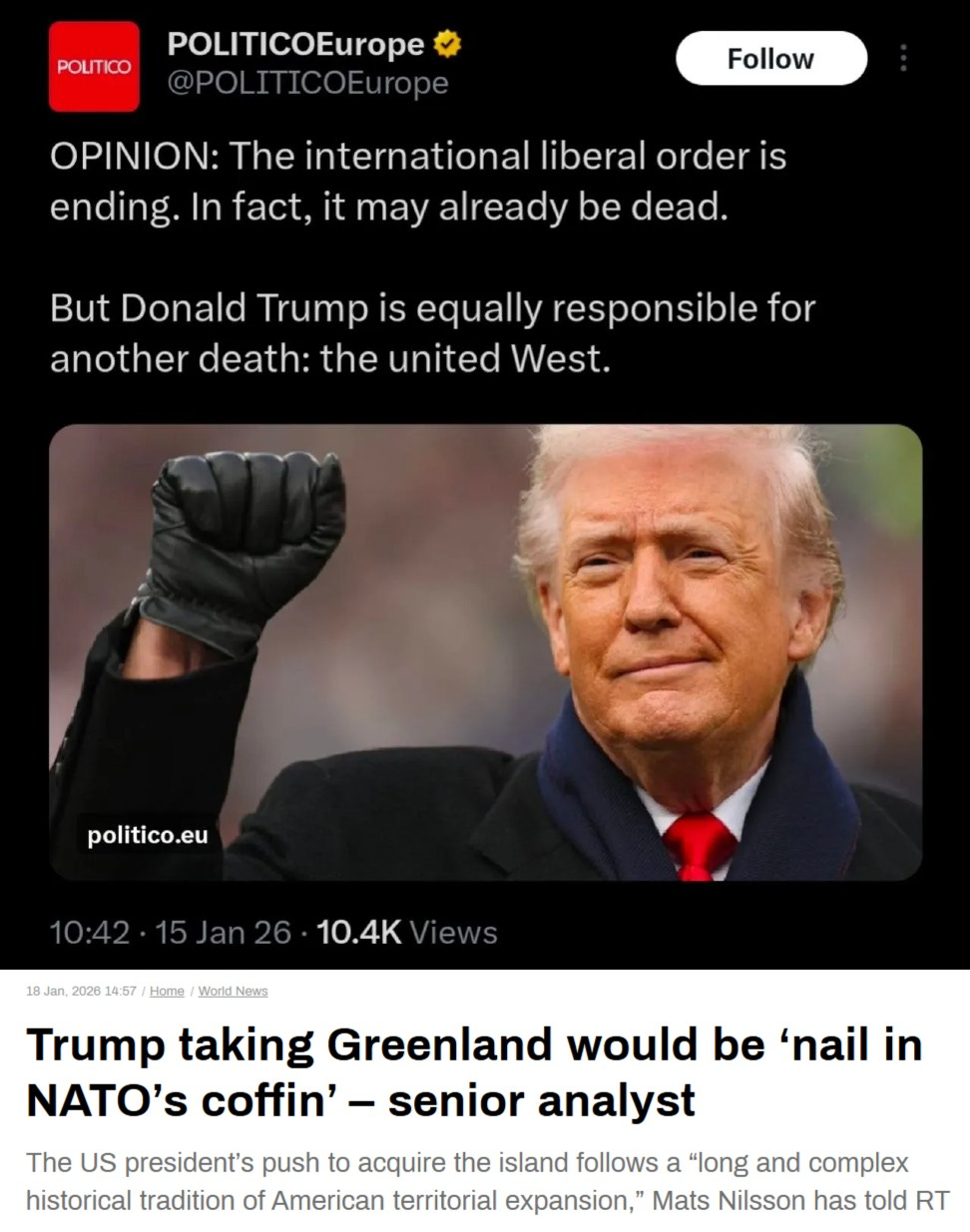
The more losses incurred, the “bigger” the over-compensation to make up for them—that’s the key to the “psychological” nature of these territorial gambits, notwithstanding their presently marginal geopolitical benefit.
How does that square with Elbridge Colby’s “grand designs”, as outlined earlier? Perhaps Trump has selectively appropriated choice portions of such strategies merely for the sake of legitimizing his moves and adorning them in the frills of genuine ‘theory’, for the sake of posterity.

Or perhaps we are the fools, and Trump has access to deeper intelligence than we’ll ever be privy to which has convinced him that these geopolitical coups de grace are an absolute necessity for the future sustainment of the US.
But this is quite unlikely: ask yourself, does Russia—as the world’s largest country, by far—really want or need to acquire another massive snowy wasteland even more barren and remote than Siberia? The idea seems preposterous.
And China, which can barely force-project onto neighboring Taiwan and convincingly establish its presence in its own South China Sea is going to “conquer” Greenland 10,000km away and man defensible bases there? The same China which operates only ONE small foreign base in Djibouti?
It is all simply absurd.
No, it seems more likely Trump has already openly revealed the real reason behind these desperate land-grabs: psychology—or more pithily, ego.
But do share your thoughts!
Is this an oversimplification? Or does it really boil down to such square and basic terms?
Special thanks to you, the paid subscribers, who are reading this paywalled Premium article—you are the core contributing members keeping this blog in healthy, steadfast operation.
The Tip Jar remains as an anachronism, an archaic and shameless bit of double-dipping, for those who just can’t help lavishing their favored humble authors with a second greedy helping of largesse.